Ten Ways of Thinking About Samuel Beckett by Brater Enoch
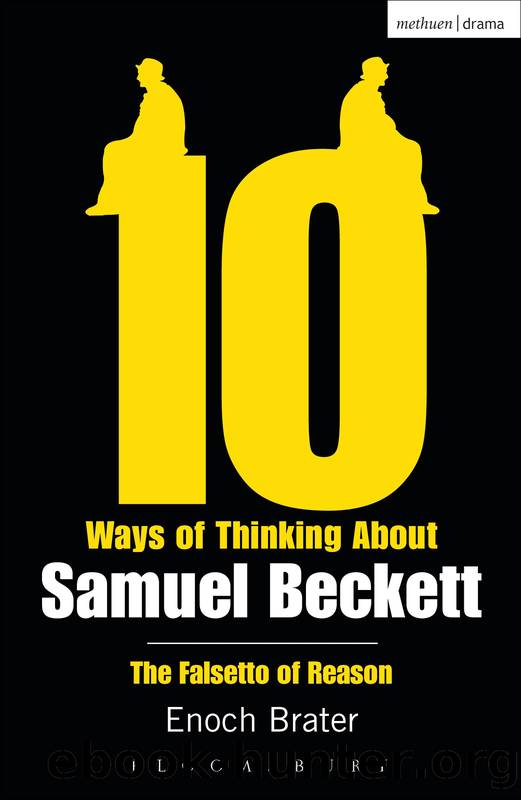
Author:Brater, Enoch.
Language: eng
Format: epub
Publisher: Bloomsbury UK
Published: 2011-11-15T00:00:00+00:00
v
What are we to make, finally, of so many devious interventions on the part of this playwrightâs complicated art and craft, working, as we might expect, overtime? It might be far too easy to dismiss this as one more example of Beckettâs obsessive control over his place in the theatre, as though his many interpreters, actors, directors and designers alike, were merely there to service him in the lead role. But I think that this is not really the case here. Artists have a long history in the western tradition of writing their signatures into their work, and they sometimes do so in oddly provocative ways, most pointedly so in the Italian Renaissance, a moment of classical revival, revisionism and adaptation that Beckett knew only too well â so much so that he could evaluate a given artistâs formal virtuosity as well as his flaws with determination, even zeal.31 Raphael paints himself into his famous âSchool of Athensâ, as does Benozzo Gozzoli in his beautiful procession of the Magi kings in the Palazzo Medici-Riccardi in Florence, the same city where Andrea del Sarto also makes his appearance known in his bold designs for the forecourt of the Annunziata. Poor Tommaso, too, dead at twenty-six, better known as Masaccio, frescoes himself into a probable self-portrait in the Brancacci Chapel at S. Maria del Carmine, as does Filippo Lippi in his pictorial cycle of St Stephen and John the Baptist in nearby Prato.
More profoundly, perhaps, Michelangelo intrudes his presence as a signature in the âDies Iraeâ of âThe Last Judgmentâ in the Sistine Chapel, and later sculpts himself as the rueful old Nicodemus in his great unfinished âPietà â. And only recently at the Uffizi restorers discovered â uncovered really â Caravaggio himself lurking in his famous rendition of âBacchusâ: in the jug to the right of this famous epicene figure the artist painted the silhouette of a person standing with one arm stretched forward and with clearly distinguished facial features, especially the nose and eye (we can now also see the collar). This is very likely Caravaggioâs self-portrait, reflected in the pitcher before him as he was painting.
Impersonality, much vaunted by grand modernist writers such as T.S. Eliot, now seems very much beside the point (Eliot was for Beckett, as he wrote in an early letter, only âTOILET spelled backwardsâ).32 The devious interventions that bring so much regenerative spark to the narrative dimensions of Beckettâs drama are there, so to speak, to lighten the load, and to remind us once again that although there is loss, a bang and a whimper, there is also the far more difficult challenge of just going on. Irony, but humour too, runs deep in what the intrepid Winnie would surely call âthose wonderful linesâ, dialogue encounters that dazzle, then strike us on further reflection with their authorâs pervasive presence: âThe creatures, the creatures,â Hamm obliges in Endgame. âEverything has to be explained to them.â Nell, not to be outdone, is gifted an opening line so outrageous
Download
This site does not store any files on its server. We only index and link to content provided by other sites. Please contact the content providers to delete copyright contents if any and email us, we'll remove relevant links or contents immediately.
| Anthropology | Archaeology |
| Philosophy | Politics & Government |
| Social Sciences | Sociology |
| Women's Studies |
The remains of the day by Kazuo Ishiguro(9089)
Tools of Titans by Timothy Ferriss(8494)
Giovanni's Room by James Baldwin(7440)
The Black Swan by Nassim Nicholas Taleb(7198)
Inner Engineering: A Yogi's Guide to Joy by Sadhguru(6837)
The Way of Zen by Alan W. Watts(6673)
The Power of Now: A Guide to Spiritual Enlightenment by Eckhart Tolle(5855)
Asking the Right Questions: A Guide to Critical Thinking by M. Neil Browne & Stuart M. Keeley(5834)
The Six Wives Of Henry VIII (WOMEN IN HISTORY) by Fraser Antonia(5559)
Astrophysics for People in a Hurry by Neil DeGrasse Tyson(5225)
Housekeeping by Marilynne Robinson(4505)
Double Down (Diary of a Wimpy Kid Book 11) by Jeff Kinney(4338)
12 Rules for Life by Jordan B. Peterson(4331)
Ikigai by Héctor García & Francesc Miralles(4312)
The Ethical Slut by Janet W. Hardy(4309)
Skin in the Game by Nassim Nicholas Taleb(4308)
The Art of Happiness by The Dalai Lama(4170)
Skin in the Game: Hidden Asymmetries in Daily Life by Nassim Nicholas Taleb(4052)
Walking by Henry David Thoreau(4002)
